Chapter Two: The Road to Independence
No one woke up one morning wanting a revolution. The colonists were a loyal, self-governing people who would have been content to stay British if Britain had left them alone. They were pushed toward independence step by step, over a dozen years, by a government that kept demanding more and stopped explaining why. The road to 1776 is the story of that pushing, and of a single question that ran underneath every mile of it: when power reaches further into people's lives, has it justified itself to a free people, or is it simply taking what it wants?
A victory that changed everything
The road begins, oddly, with a victory. In 1763 Britain won a long war against France for control of North America. It came out triumphant, deeply in debt, and newly determined to manage its colonies more tightly than ever before. For generations the colonies had run their own towns and assemblies with little interference from London. Now London reached in.
The British argument was not foolish, and we should be fair to it, because a quarrel understood from only one side is not understood at all. The war had been fought in part to defend the colonies, it had nearly doubled the national debt, and there was now a vast frontier to guard. From London it seemed plain justice that the colonists should help pay for their own defense. The colonists did not deny that government costs money. What they denied was that a Parliament in which they had not a single elected voice could reach into their pockets without asking. That, to a free Englishman, was not taxation. It was being treated as a subject who did not count. The fight was never really about whether to pay. It was about who had the right to decide.
The measures came one after another, and each one taught the colonists a little more. A tax on paper and documents, the Stamp Act, drew the cry that would define the age: no taxation without representation. The colonists answered not only with words but with action, refusing to buy British goods until the tax was repealed, and that victory taught them a second lesson, that standing together could move the most powerful empire on earth. New taxes followed, then soldiers in the streets of Boston, then blood on the snow when troops fired into a taunting crowd and killed five men.
And here, with passions at their highest, something in the American character showed itself. The soldiers who fired were put on trial, and their defense was taken up by John Adams, a leading patriot who believed that even hated men were owed a fair hearing, and that a cause built on liberty could not be built on a mob. Most of the soldiers were acquitted. To stand up in open court and defend the very men who had shot your neighbors is the mark of a people already governed, in their better moments, by law rather than by rage. That instinct, that even an enemy is owed justice, would outlast the war and help shape the republic that followed it.
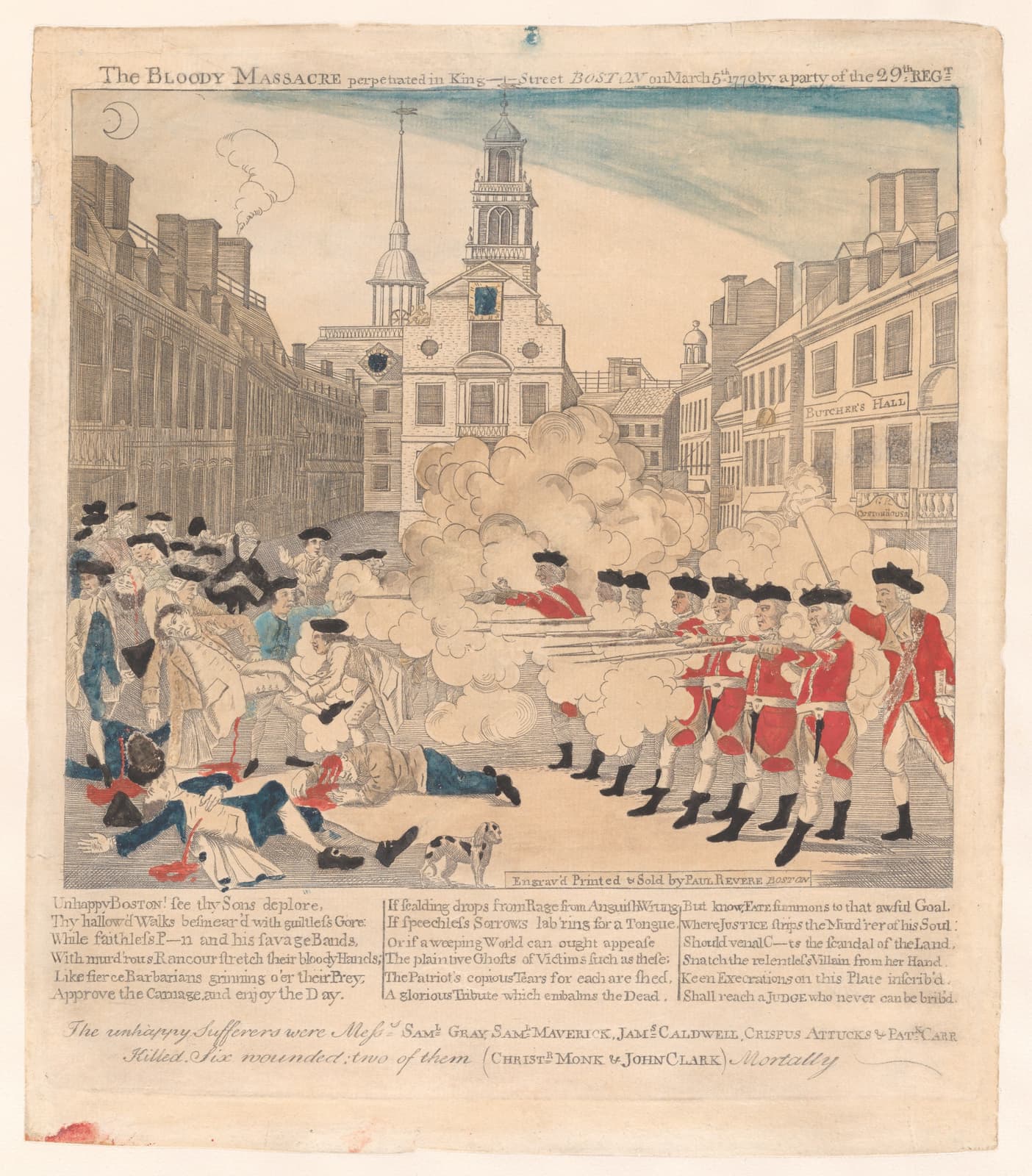
Paul Revere, The Bloody Massacre Perpetrated in King Street Boston on March 5th 1770 (1770)
A conservative revolution
It is easy to get the colonists' argument backward, and getting it right is the key to the whole period. They were not wild radicals tearing down the social order to build something brand new. Their argument was conservative. They were defending rights they believed they already held as Englishmen, the chief of which was the right not to be taxed by a body in which they had no voice. Picture them as bomb-throwers and you misread the entire Revolution.
The liberty framework sharpens the question they were really asking. Freedom is the natural condition of a people, and the burden of proof always lies on the one who would coerce. British power had expanded after 1763, with new taxes, tighter control, and a standing army. The question was whether that expansion had justified itself to a people who had governed themselves for a hundred years. The colonists, most of them serious readers of the Bible, did not answer that question lightly. They knew Scripture commands honor to governing authority.
"Every person is to be in subjection to the governing authorities. For there is no authority except from God, and those which exist have been appointed by God." (Romans 13:1).
But the same passage that grants the authority also defines the work it is given to do, and the work is the boundary. The ruler is no terror to good conduct, only to evil.
"For rulers are not a cause of fear for good behavior, but for evil. Do you want to have no fear of that authority? Do what is good, and you will have praise from the same; for it is a minister of God to you for good. But if you do what is evil, be afraid; for it does not bear the sword in vain, for it is a minister of God, an avenger who brings wrath on the one who practices evil." (Romans 13:3-4).
Peter names the same purpose, that governors are "sent by him for the punishment of evildoers and the praise of those who do good" (1 Peter 2:14). Here is the move the colonists made, and serious readers of Scripture made it carefully. Authority is from God, but it is given for a defined end: to punish evil and to protect those who do good. A ruler who turns that end upside down, who becomes a terror to the good and a shelter to the evil, has stepped past the authority God actually granted him. To hold such a ruler to the bounds God set for him is not to oppose God's ordinance but to honor it. This is how John Witherspoon and the resistance pulpits read Romans 13, and it is why the colonists, who genuinely feared God's ordinance, did not understand 1776 as rebellion against it.
There is a clearer and narrower case still. When a government commands what God forbids, or forbids what God commands, the Christian's path is not in doubt, for the apostles had walked it already.
"But Peter and the apostles answered and said, "We must obey God rather than men." (Acts 5:29).
That is the plain case. Resistance to a government that has only overreached, that has grown unjust without yet commanding outright sin, is the older and harder question, the one serious Christians have weighed for centuries under the heading of the lesser magistrate, and it is to be weighed soberly, not waved like a banner. The colonists wrestled with it as men who feared both tyranny and anarchy, and a thoughtful Christian may still come down on either side of how they judged. The point worth keeping is that they did not treat it as a slogan. They believed their lawful rights were being usurped by a Parliament reaching past its just bounds, and that to defend those rights was to hold a power to its God-given purpose, not to throw off authority itself.
When words ran out
Positions hardened until words ran out. When colonists threw a shipment of British tea into Boston harbor rather than pay the tax on it, Britain answered by closing the port and stripping Massachusetts of much of its self-government. The punishment was meant to isolate one unruly city. It did the opposite. The other colonies, seeing that what had been done to Boston could be done to any of them, sent delegates to a Continental Congress to act together for the first time.
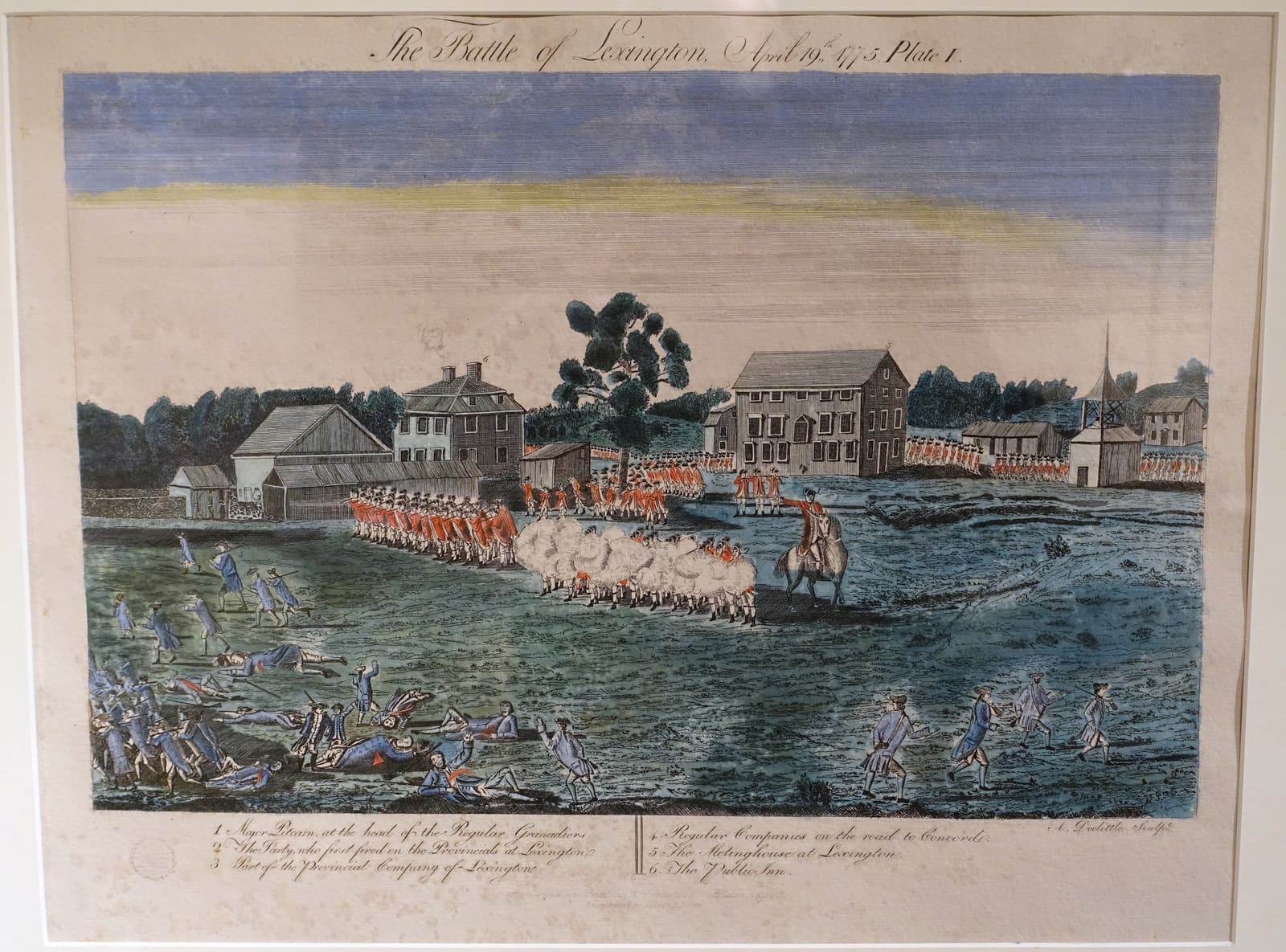
Amos Doolittle, The Battle of Lexington, April 19, 1775 (engraving, 1775)
In April of 1775, at Lexington and Concord, the argument became a war. British troops marching to seize colonial weapons met militia on a village green, and someone fired the shot a later poet called the shot heard round the world. These were not professional soldiers. They were farmers and shopkeepers and blacksmiths who had left their plows standing in the field and taken up muskets against the foremost army of the age, with little idea of all they were beginning. By the end of that first day they had bloodied the British column and driven it back to Boston, and a long quarrel over taxes and rights had become a shooting war that no one now knew how to stop.
The deepest of the colonists' teachers had grounded their liberty not in any act of Parliament but in the gift of God. Samuel Adams put it plainly: "The right to freedom being the gift of God Almighty, it is not in the power of man to alienate this gift and voluntarily become a slave."1 A freedom held as a gift from God is a freedom no government bestows and none can justly strip away. But such freedom is never a license to do as one pleases. It is held in answer to the God who gave it.
"Act as free people, and do not use your freedom as a covering for evil, but use it as slaves of God." (1 Peter 2:16).
For Reflection
"God had commanded them to teach in the name of Christ, and therefore they ought to do it, though the chief priests forbade them. Note, Those rulers set up in opposition to God, and have a great deal to answer for, who punish men for disobedience to them in that which is their duty to God."
Matthew Henry, Commentary on the Whole Bible2
Henry wrote that on the very verse the colonists kept returning to. A people who had learned to fear God above the magistrate were a people hard to govern by threats, and harder still to silence, because the worst a ruler could do to them was never the thing they feared most.
"Trembling before man brings a snare, But he who trusts in Yahweh will be set securely on high." (Proverbs 29:25).
Hymn
God Bless Our Native Land
This prayer for the nation came into English from a German hymn by Siegfried Mahlmann, translated by Charles T. Brooks in 1834 and recast by John S. Dwight in 1844. It is the cry of a people who know their land cannot save itself, asking the Ruler of wind and wave to keep the country through storm and night by His own great might. The tune is AMERICA.3
God bless our native land!
Firm may she ever stand
Thro' storm and night!
When the wild tempests rave,
Ruler of wind and wave
Do Thou our country save
By Thy great might.For her our prayer shall rise
To God above the skies;
On Him we wait.
Thou who art ever nigh,
Guarding with watchful eye,
To Thee aloud we cry,
God save the State!