Chapter One: The Roots, Before 1776
When Ferdinand and Isabella sent Columbus westward in 1492, they were after gold, glory, and advantage for a crown. Freedom was nowhere in their thinking, and the peoples already living on this side of the ocean, in nations old and settled long before any European saw them, would pay dearly for what followed. Yet the voyage those monarchs launched for their own narrow ends loosed ripples no crown could foresee or control, and two and a half centuries later, under a different flag and for reasons no one in that Spanish court would have recognized, a freedom would ring out from this continent to the ends of the earth. Greater still, the gospel of Christ would take root on these shores and reach souls who could have found it no other way, an eternal mercy that the men who came for gold never meant to carry. History often runs this way. God bends the purposes of men toward ends they never intended, and the story of this nation is, from its very first page, a story of human aims overruled.
The story does not really begin with that voyage, though, nor with the explorers and ships that came after it. It begins with ideas, and with the kind of people those ideas produced, because that is what was finally planted on these shores once the ripples had run their course. A great tree does not appear on the day you first notice it. By the time it is tall enough to sit under, its roots have been at work in the dark for a lifetime. The United States was declared in a single summer, but the convictions that made the declaration possible had been growing in colonial soil for more than a century before anyone signed anything. Four things grew together there, and when they had grown, a free people was ready. A faith that taught ordinary men to govern themselves under God. A tradition of law that said even the king was not above the law. An older wisdom that warned a republic cannot survive without virtue. And a great revival that, for the first time, made thirteen scattered colonies feel like one people.
A people who could govern themselves
The most important thing about the men and women who settled the northern colonies is what they believed about authority. They were the children of the Reformation, people who had learned to read the Bible for themselves and to answer to God directly, and a person who has learned to stand before God on his own conscience is not easily told that his worship, or his life, must be dictated by a distant power.
In 1620 a small company of these people, the Pilgrims, landed on the wrong coast. They had crossed the ocean to escape a church that told them how to worship, and a storm had carried them to a place where no English law reached them and no governor held any authority over them at all. They could have dissolved into every man for himself on a freezing shore. Instead, before they went ashore, they did something quietly remarkable. They wrote and signed the Mayflower Compact, binding themselves together into a civil body and promising to make and obey just and equal laws for the common good.1 Ordinary people, by their own act, on their own authority under God, chose the rules they would live under rather than waiting to receive them from a crown across the sea. That winter killed nearly half of them. The survivors buried their dead, and when the Mayflower sailed home that spring, not one of them was aboard.
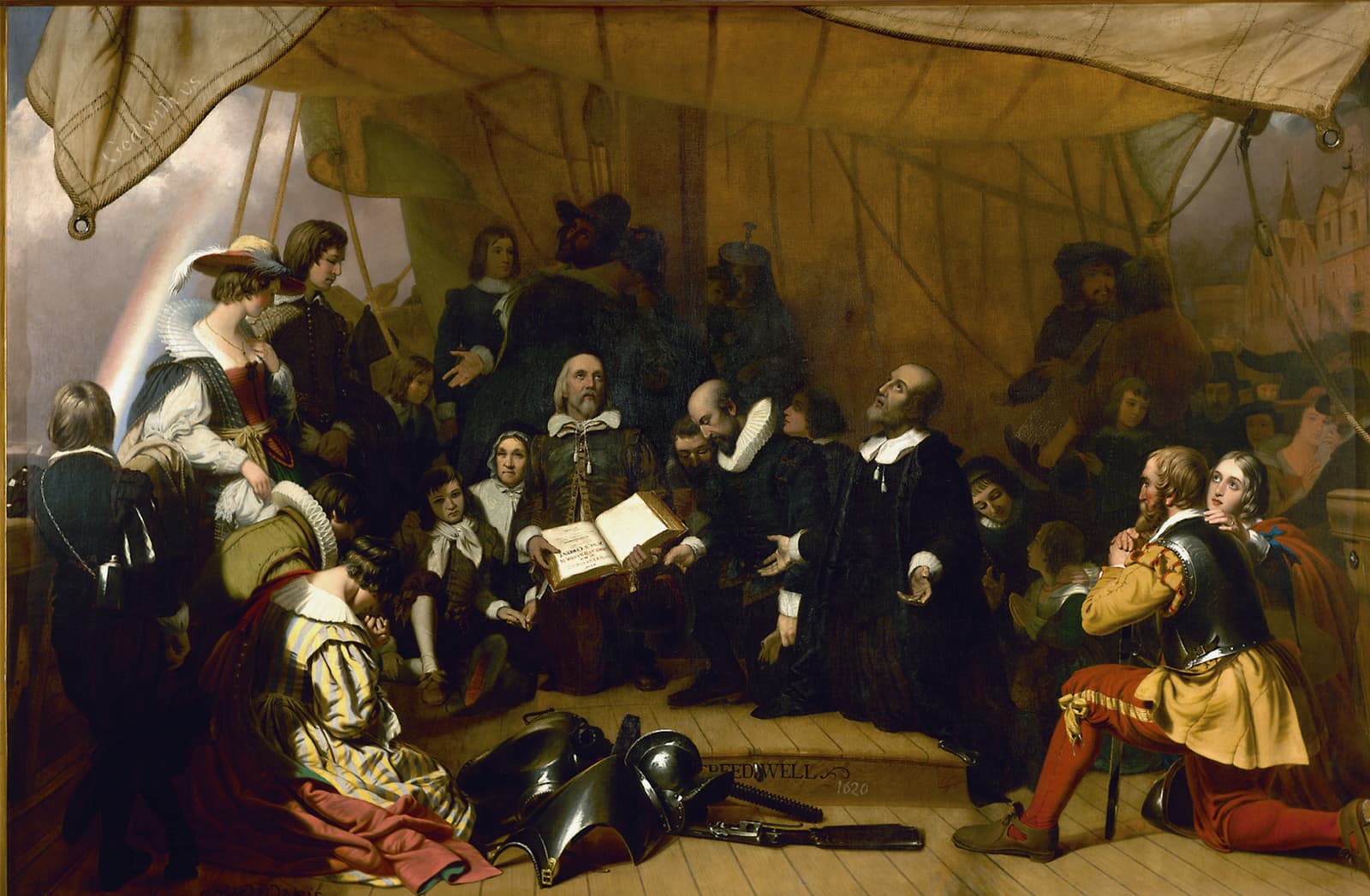
Robert W. Weir, Embarkation of the Pilgrims (1844)
Ten years later the Puritans planted Massachusetts Bay, and their leader, John Winthrop, told them what kind of community they were to be. They would be, he said, as a city upon a hill, watched by the world and answerable to God.2 Out of that covenant faith grew a covenant politics: the town meeting, the self-governing congregation, a whole people in the habit of holding themselves to a law higher than their own wishes. The single most consequential idea in early American life was planted here, that legitimate authority rests on the consent of a people who answer to God.
One hard truth belongs beside that achievement. The same people who crossed an ocean for the freedom to follow their own conscience did not, once they held power, grant that freedom to others. A dissenter in Massachusetts Bay could be fined, banished, or worse. They had learned that conscience answers to God and not to the state, and they had not yet learned to extend that mercy to the neighbor who read God differently. Liberty claimed only for oneself is half-learned, and the new world would take the better part of two centuries to finish the lesson.
A law above the king
The settlers carried something else across the ocean: a long English tradition that no ruler stands above the law. For centuries, Englishmen had insisted that the king himself was bound by ancient rights and customs, and that a power which broke them had broken faith. By the colonial era this conviction had a great teacher in William Blackstone, whose writings the founders read closely. Blackstone taught that human law has no authority of its own when it contradicts the law of nature and the revealed law of God, and that the whole purpose of government is to secure the rights people already possess.3
That last point is the hinge of everything. The colonists did not think of their liberties as gifts the government handed down and could take back. They thought of them as theirs already, held under God, and the government's one job was to protect them. When London later began to tax and command them without their consent, they did not feel they were asking for something new. They felt they were defending something old that was being stolen.
A virtue without which freedom dies
The colonists had also drunk from an older well, the wisdom of Greece and Rome about what a self-governing people requires. The ancient republics had taught a sobering lesson: liberty does not run on good intentions. A free people must be a virtuous people, willing to put the common good above private appetite, or its freedom rots from the inside and it hands itself over to whoever promises order. You cannot keep a republic with selfish citizens. The founders knew this, quoted it, and feared it, and it is one of the quiet warnings woven through everything they built.
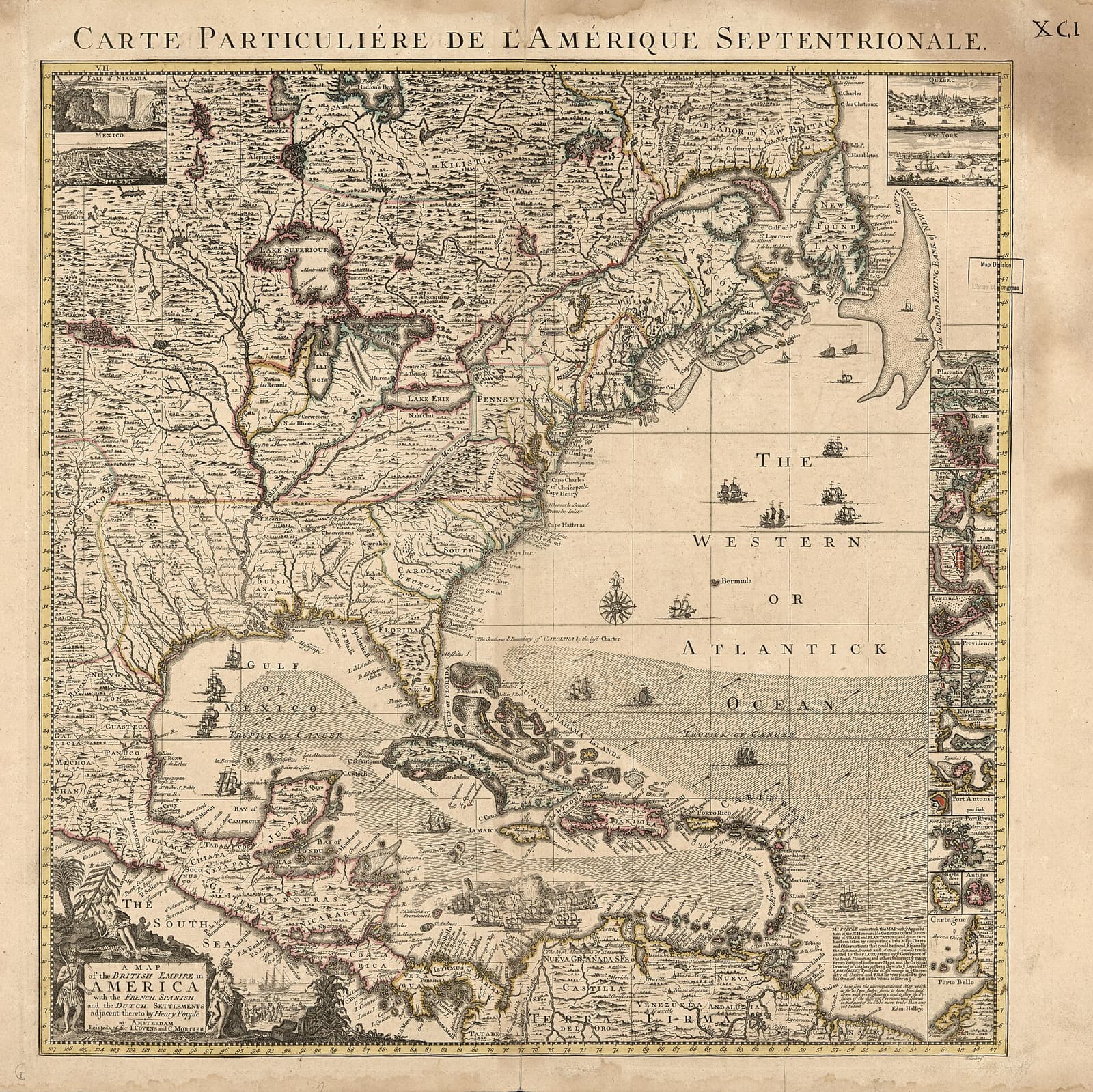
Emanuel Bowen, A Map of the British Empire in America with the French, Spanish and Dutch Settlements Adjacent Thereto (London, 1741)
Scripture had said the same thing more plainly, and the colonists knew that too.
"Righteousness exalts a nation, But sin is a disgrace to any people." (Proverbs 14:34).
The fire that made one people
For all of that, the thirteen colonies were still thirteen separate places, founded at different times by different people for different reasons, with little sense of belonging to one another.
What first knit them together was not a war or a law. It was a revival.
In the 1730s and 1740s a great spiritual awakening swept the colonies. Preachers like Jonathan Edwards and the tireless George Whitefield pressed one insistent message on rich and poor alike: that a person must be born again, and that the new birth is a work God does, not a ceremony a church performs.
"Do not marvel that I said to you, 'You must be born again.'" (John 3:7).
The message leveled people. It told the respectable churchgoer and the frontier farmer the same thing, that belonging to a church and being made new by God were not the same, and that no one could earn the second. And because it crossed every colonial and denominational line at once, carried by preaching that ordinary people could weigh against their own Bibles, it gave the colonies their first shared experience. For the first time, a man in Georgia and a man in Massachusetts had lived through the same thing together. A people cannot easily act as one until it has first felt itself to be one, and the revival is where that feeling began.
The connection to what came later should be stated at exactly its true strength and no more. The Awakening did not cause the Revolution. It shaped the soil from which the Revolution would grow. It taught ordinary colonists to read for themselves, to judge even a famous preacher against the truth, and to answer to God before they answered to any earthly authority. A people in that habit of mind is not easily told it has no rights its rulers are bound to respect. A generation later, that would matter a great deal.
The roots were now deep: a self-governing faith, a law above the king, a sober knowledge that freedom needs virtue, and a fresh sense of being one people under God. The tree was ready. All it needed was a storm to make it stand.
"You are the light of the world. A city set on a hill cannot be hidden;" (Matthew 5:14).
For Reflection
"These things being so, we do not attribute the power of giving kingdoms and empires to any save to the true God, who gives happiness in the kingdom of heaven to the pious alone, but gives kingly power on earth both to the pious and the impious, as it may please Him, whose good pleasure is always just. For though we have said something about the principles which guide His administration, in so far as it has seemed good to Him to explain it, nevertheless it is too much for us, and far surpasses our strength, to discuss the hidden things of men's hearts, and by a clear examination to determine the merits of various kingdoms.
[. . .]
Manifestly these things are ruled and governed by the one God according as He pleases; and if His motives are hid, are they therefore unjust?"
Augustine of Hippo, The City of God4
Augustine wrote those words about empires long dead, yet they reach every nation that has risen since, this one included. The land was here, the peoples were here, and the timing that brought a Bible-reading people to an open continent was never theirs to arrange. The kingdom belongs to God, and He rules over the nations He has made.
"For the kingdom is Yahweh's And He rules over the nations." (Psalms 22:28).
Hymn
Great God of Nations, Now to Thee
This hymn comes from Alfred A. Woodhull, a Presbyterian physician, and first appeared in the Presbyterian Psalms and Hymns published at Princeton, New Jersey, in 1829. It is a young nation's prayer of gratitude and dependence, and it asks at the end to be kept in the fear of God, a fitting note for a story that begins by placing the whole of it under the One who appoints the times and the boundaries of the nations. The tune is GROSTETTE, composed by Henry W. Greatorex in 1851.5
Great God of nations, now to Thee
Our hymn of gratitude we raise;
With humble heart and bending knee
We offer Thee our song of praise.Thy name we bless, almighty God,
For all the kindness Thou hast shown
To this fair land the pilgrims trod,
This land we fondly call our own.Here freedom spreads her banner wide
And casts her soft and hallowed ray;
Here Thou our fathers' steps didst guide
In safety through their dangerous way.We praise Thee that the Gospel's light
Through all our land its radiance sheds,
Dispels the shades of error's night,
And heavenly blessings round us spreads.Great God, preserve us in Thy fear;
In danger still our guardian be;
O spread Thy truth's bright precepts here;
Let all the people worship Thee.
Footnotes
-
The Mayflower Compact (1620). The signers covenanted to "combine ourselves together into a civil Body Politick" and to frame "just and equal Laws... for the general good of the Colony." (Available in the GraceHaven library.) ↩
-
John Winthrop, "A Model of Christian Charity" (1630). ↩
-
William Blackstone, Commentaries on the Laws of England (Oxford: Clarendon Press, 1765-1769), bk. 1, intro., sec. 2. (Available in the GraceHaven library.) ↩
-
Augustine of Hippo, The City of God, bk. 5, ch. 21 (c. 426), trans. Marcus Dods. (Available in the GraceHaven library.) ↩
-
Alfred A. Woodhull, "Great God of Nations, Now to Thee," in Presbyterian Psalms and Hymns (Princeton, NJ, 1829); tune GROSTETTE by Henry W. Greatorex (1851). ↩