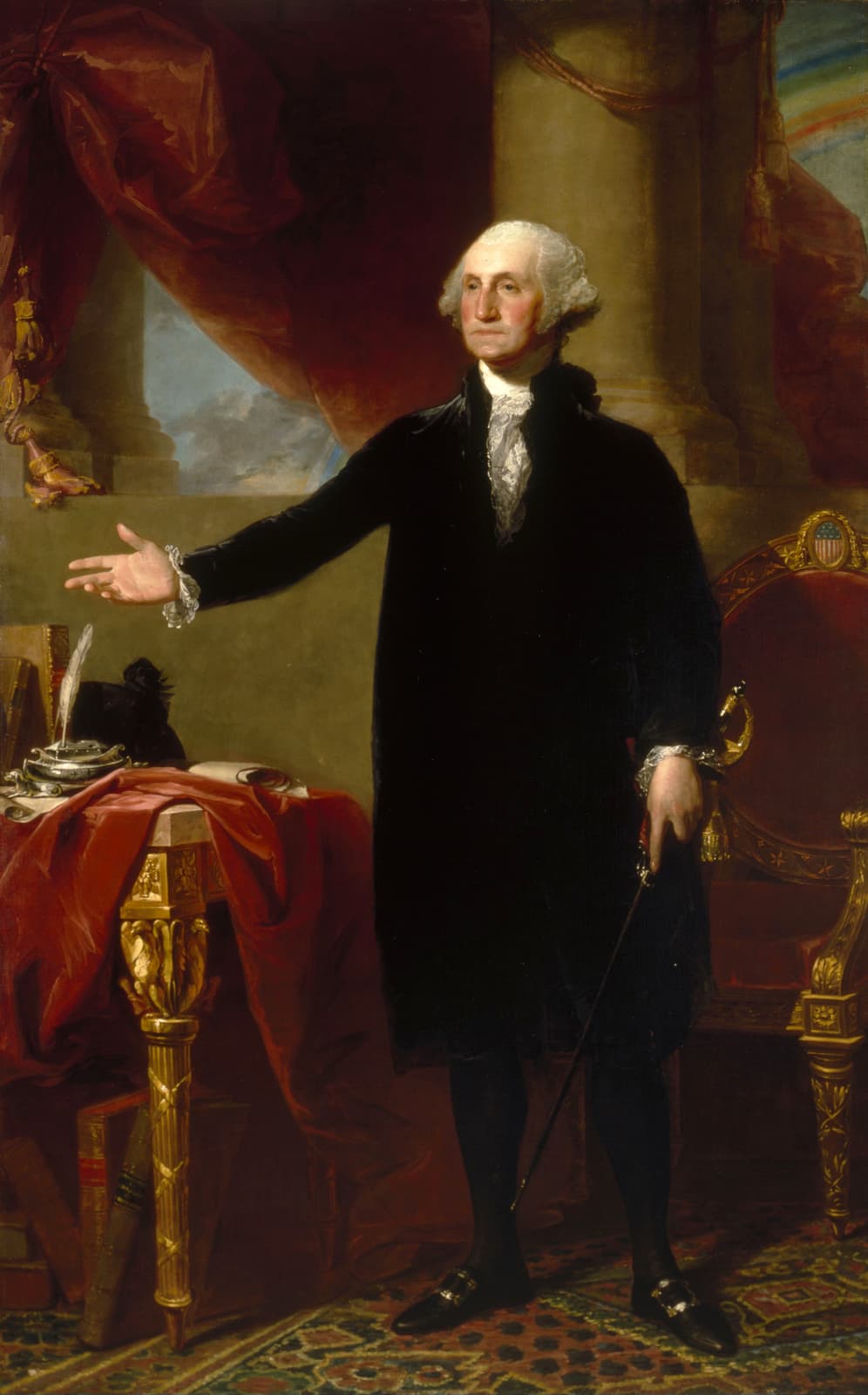
Gilbert Stuart, George Washington, Lansdowne Portrait (1796).
There are two things people mean by freedom, and the founders prized one of them and feared the other.
The first is the freedom to do what is right without a tyrant's boot on your neck: ordered liberty, freedom under God and under law. The second is the freedom to do whatever you happen to want, appetite with no fence around it. The founders, and the Scriptures they had steeped in, gave the second one a harder name. They knew it was not liberty's cousin but its undoing.
The freedom that eats itself
A republic is, by definition, a people governing themselves. And a people who cannot govern their own appetites cannot govern anything else for long. Turn freedom into a license for every impulse and you do not get more freedom, you get less, because a society of unrestrained appetites quickly becomes ungovernable, and frightened people have always been willing to hand their liberty to whoever promises to restore order. License does not lead to liberty. It leads, by a surprisingly short road, to a strongman.
Scripture had named the counterfeit plainly.
"For you were called to freedom, brothers; only do not turn your freedom into an opportunity for the flesh, but through love serve one another." (Galatians 5:13).
Freedom, in that verse, is real and good and given. But it arrives with a limit written into its own purpose. It was never granted so that each person could chase whatever he craved. It was granted for love, for the serving of one another, and a freedom spent on the self alone is a freedom already curdling.
Liberty in law
This is why the founders built limits into liberty rather than treating limits as liberty's enemy. They bounded the power of the majority as carefully as they bounded the power of a king, because they did not trust unchecked power in anyone's hands. And they knew the deepest limit could not be written into any law at all, because it had to live inside the citizen. One of the nation's best-loved hymns prays for exactly that, asking God to "Confirm thy soul in self-control, Thy liberty in law." A free people stays free by governing itself from the inside, or it does not stay free for long.
The two freedoms, and why the founders feared the wrong one, run through the booklet we wrote for the country's 250th anniversary, Liberty Under God, made for families to read aloud together, glad in the gift and clear about its limits, with the final hope set on Christ rather than the nation. It is free to read in full, and free to share.
It is also why GraceHaven Academy treats self-government as something to be taught, not assumed. A child who learns the difference between liberty and license, and who learns to govern himself, is being handed the one thing a free country cannot survive without. Its American History course is one place that lesson is opened up.
Liberty has limits. That is not the fine print on freedom. It is the thing that keeps freedom alive.
See our new video series that covers this book as well. Liberty Under God | Episode 3: The Declaration — Where Do Our Rights Come From?